
Sourcing Luxury Novelties: Securing Professional Dollhouse Furniture Jewelry Case Factory Price for Retail Chains
Oct 12, 2026
Wenzhou, Zhejiang Oct 12, 2026 (Issuewire.com) - Retail chains expanding their luxury novelty collections face a complex sourcing landscape when evaluating custom display packaging. As miniature sofa and dollhouse furniture packaging formats gain widespread popularity across international vanity markets, procurement directors must analyze the technical cost structures that dictate factory quotations.
Securing a competitive Professional Dollhouse Furniture Jewelry Case Factory Price (https://www.jinzecrafts.com/products/creative-jewelry-storage-box-for-home-and-gifts/) requires a thorough understanding of raw material grades, structural core engineering, and manual assembly hours. Luxury novelty items demand higher visual precision than standard gift boxes, making cheap manufacturing shortcuts obvious to retail consumers.
Rather than focusing solely on initial unit costs, enterprise buyers examine the complete manufacturing workflow to prevent quality degradation during large-scale commercial production. This procurement guide examines the primary cost drivers behind dollhouse furniture jewelry cases, enabling retail chains to negotiate transparent pricing models while maintaining strict quality standards across global retail distribution networks.
Demystifying Novelty Packaging Quotations: Why Dollhouse Furniture Jewelry Boxes Command Variable Pricing
Procurement directors frequently encounter significant price variations when requesting factory quotes for dollhouse furniture jewelry cases across different supply chains (https://www.jinzecrafts.com/products/). These pricing discrepancies stem from fundamental differences in structural core selections, material specifications, and manual assembly techniques.
Unlike standard rectangular gift boxes that rely on automated folding machinery, miniature furniture packaging requires multi-piece structural frameworks and hand-tailored textile application. Consequently, unusually low factory quotes often signal compromised material standards, such as flimsy paperboard cores or low-density synthetic fabrics that deform under environmental stress during transit.
Furthermore, evaluating packaging quotations requires buyers to look beyond the initial FOB unit cost. A deceptively cheap quotation can lead to higher overall expenditure if products suffer from structural warping, glue bleed-through, or fabric peeling during ocean transit. Inconsistent ring slots or misaligned lids can also cause high consumer return rates at the retail level.
Sourcing teams must carefully analyze how candidate factories calculate operational overheads, tool setup fees, and multi-stage quality control procedures. By understanding the operational factors behind variable factory quotes, retail chains can distinguish between short-term cost cutting and genuine manufacturing efficiency.
Ultimately, partnering with transparent suppliers ensures that product durability aligns with brand expectations while securing stable retail margins across diverse global sales channels.
The Engineering Bill of Materials: Precision Tooling, Fabric Grades, and Alloy Hardware Costs
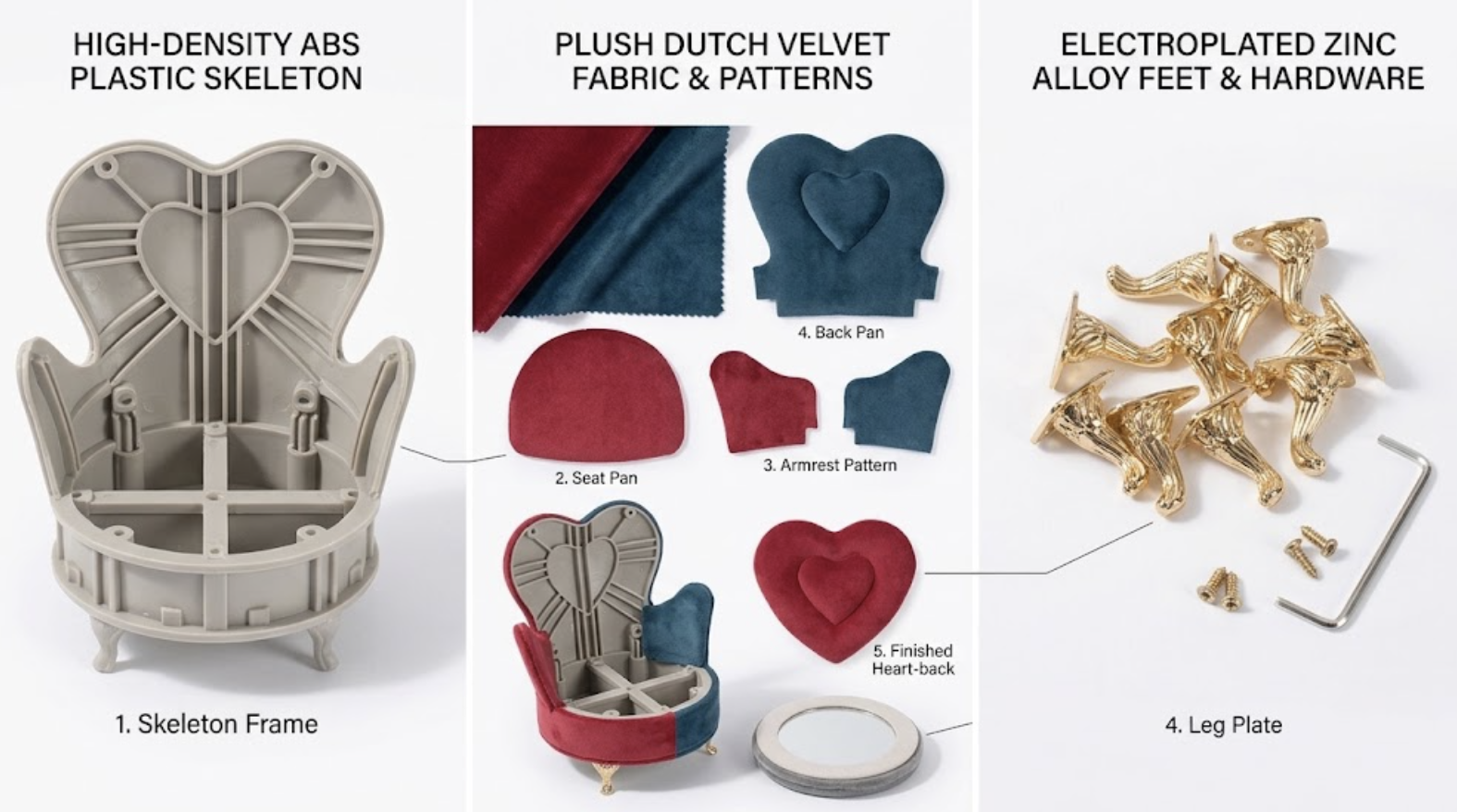
The physical Bill of Materials (BOM) forms the core foundation of any factory quotation for dollhouse furniture packaging. Structural stability depends heavily on the internal core material. High-quality manufacturers utilize precision injection-molded ABS plastics or dense rigid board frameworks to establish a rigid skeleton. In contrast, lower-tier alternatives rely on soft, compressed paperboard that easily warps under humidity or transport pressure.
Mold creation for multi-component furniture frames--such as heart-shaped backrests and contoured armrests--requires upfront capital investment, which factories amortize across high production volumes.
Textile selection and metallic hardware also influence unit pricing significantly. Premium Dutch velvet offers high pile density, rich color depth, and superior abrasion resistance, ensuring that surfaces remain plush throughout retail store handling.
Specialized cases, such as a 23.5 by 9.5 by 12.5 centimeter miniature sofa format, require precise fabric consumption calculations to prevent raw material waste while offering vibrant color options like white, orange-yellow, and blue-green. Additionally, custom electroplated zinc alloy feet, embedded vanity mirrors, and micro-hinges add functional elegance while contributing to the total bill of materials.
Selecting certified, high-grade raw components prevents surface tarnishing and mechanical failure, securing long-term product value for international retail chains.
Labor Hours and Manual Dexterity: Quantifying the Cost of Master Craftsmanship in Micro-Upholstery
Manual labor constitutes a major portion of the unit cost when manufacturing complex dollhouse furniture packaging. Wrapping soft textiles over compound curves, recessed seat cushions, and miniature armrests requires exceptional hand dexterity that automated machinery cannot replicate. Precise fabric stretching prevents wrinkles, loose seams, and adhesive bleed-through along delicate corner joints.
Consequently, the skill level and retention rate of the factory workforce directly affect both daily production throughput and overall defect rates.
Within this specialized manufacturing sector, Zhejiang Jinze Crafts Co.,Ltd (https://www.jinzecrafts.com/about/) maintains an integrated production facility powered by a dedicated 150-person workforce. Crucially, all workshop artisans possess 20 years of individual crafting experience in specialized hand assembly.
These master craftspeople execute intricate upholstery steps with remarkable accuracy, applying non-toxic adhesives at precise temperatures to maintain clean fabric edges and neat corner seals. Their extensive experience minimizes raw material waste and ensures consistent seam symmetry across large order volumes.
By investing in a highly skilled, stable workforce, established factories eliminate quality defects, providing retail chains with reliable, handcrafted novelty packaging at predictable, transparent factory prices.
Compliance, Audits, and Patent Risk Mitigation: Calculating the Hidden Overhead of Safe Imports
Enterprise retail chains must account for regulatory compliance and risk mitigation when calculating the total cost of imported novelty goods. Reputable suppliers incorporate the costs of safety testing, social audits, and intellectual property protection directly into their operational pricing.
For example, raw materials must undergo independent laboratory testing to verify compliance with international chemical standards, such as European REACH regulations regarding non-toxic glues and heavy-metal-free metallic platings. Meeting these chemical safety benchmarks prevents costly customs impoundments at destination ports.
Furthermore, social compliance audits represent a crucial safeguard for global brand equity. Factories holding Business Social Compliance Initiative (BSCI) certification demonstrate strict adherence to fair wages, workplace safety, and ethical labor standards. This certification eliminates reputational risks for international importers supplying major department stores and supermarket networks.
In addition, holding valid structural patents, such as design patent ZL 2019 3 0394790.X, protects buyers from legal disputes and pricing erosion caused by unauthorized market copies. Factoring regulatory compliance and patent protection into initial supplier evaluations safeguards retail chains against unexpected legal liabilities and costly product recalls.
MOQ Scaling and Total Cost of Ownership (TCO): Leveraging 25 Years of Integrated Export Expertise
Minimum Order Quantity (MOQ) thresholds play a pivotal role in optimizing factory pricing for custom dollhouse furniture packaging. Higher order volumes allow manufacturers to amortize fixed setup costs, custom mold development, and fabric dye-lot runs efficiently across more units. Consequently, retail chains that plan seasonal inventory in advance achieve significantly lower per-unit factory prices.
Sourcing directors must analyze volume discount structures and custom OEM or ODM logo printing options to identify the optimal balance between inventory holding costs and unit production savings.
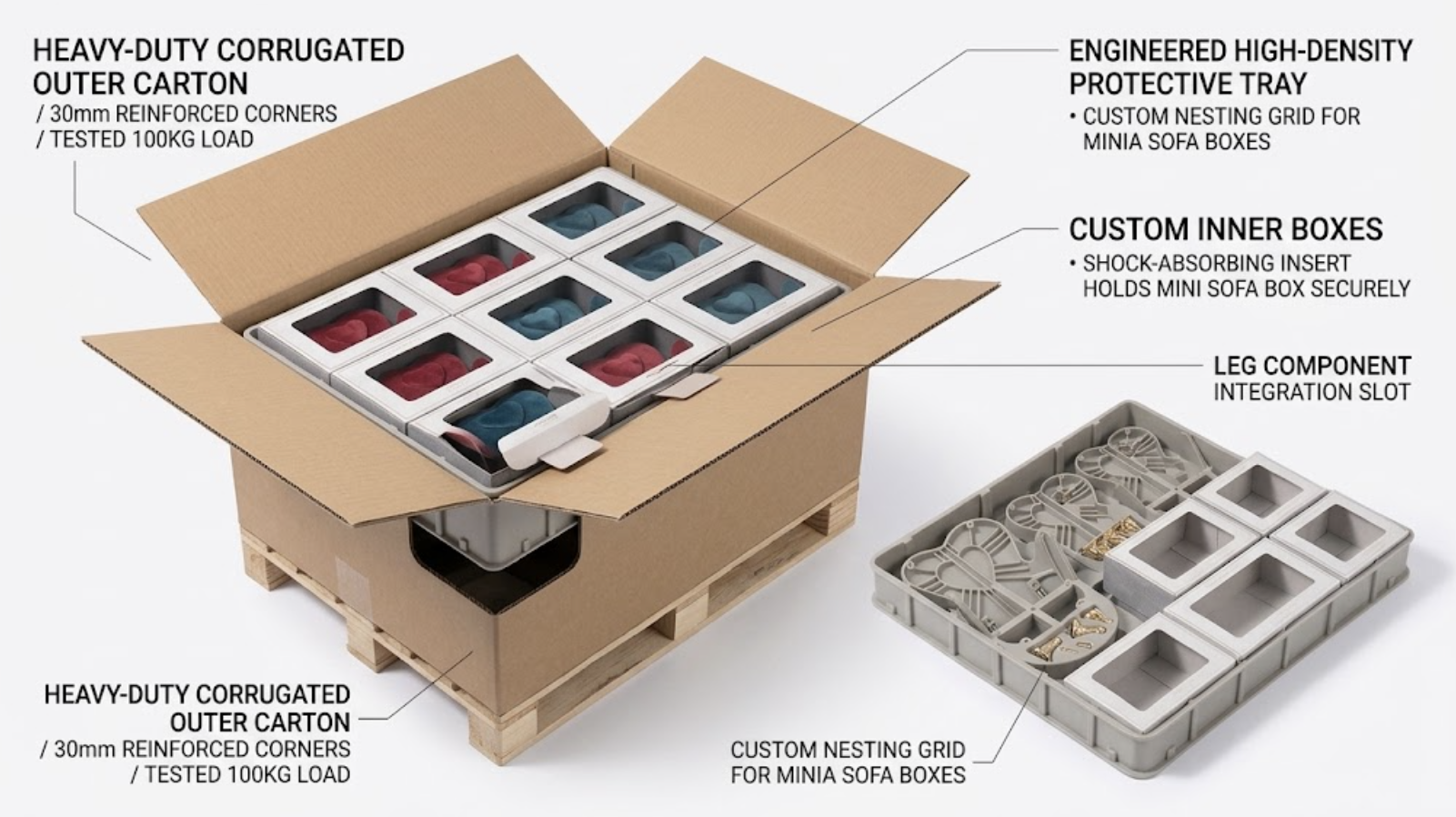
Logistics engineering also dictates the Total Cost of Ownership (TCO) for bulky, hollow novelty shapes. Specialized packaging engineers design custom nested inner boxes and high-strength corrugated master cartons to maximize container loading density. This space optimization protects delicate velvet surfaces and alloy metal feet while reducing volumetric freight charges per unit.
Drawing upon 25 years of industry-trade integration, experienced exporters streamline customs clearance, shipping documentation, and international logistics. Having successfully supplied global market leaders--including Walmart, Disney, Sanrio, and major UK and German supermarket chains--established manufacturers deliver fully compliant, cost-effective novelty packaging directly to global distribution hubs.
For comprehensive details regarding custom dollhouse furniture jewelry case capabilities, manufacturing specifications, and factory pricing structures, visit https://www.jinzecrafts.com/.
Source :Zhejiang Jinze Crafts Co.,Ltd
This article was originally published by IssueWire. Read the original article here.
More News









Recommended





YOUR NEWS, OUR NETWORK.
Do you have Great News you want to tell the world?
Be it updates about your business or your community, you can make sure that it’s heard by submitting your story to our network reaching hundreds of news sites across 6 verticals.