Ukraine invasion: What to know as Putin alerts nuclear force
Feb 27, 2022
Russian President Vladimir Putin has put his nuclear forces on increased alert, in an unprecedented escalation of tension with the West since the collapse of the Soviet Union over Russia’s assault on Ukraine
Russian President Vladimir Putin put his nuclear forces on increased alert on Sunday in an unprecedented escalation of tensions with the West. Russia’s massive conventional military assault on Ukraine entered its fourth day with fighting in the streets of the country’s second-largest city, Kharkiv.
Here are the things to know about the Russian invasion of Ukraine and the security crisis in Eastern Europe:
RUSSIA PUTS NUCLEAR FORCES ON ALERT
In a shocking move that immediately unearthed fears many thought were permanently buried by the end of the Cold War, Putin ordered Russian nuclear weapons prepared for increased readiness to launch, ratcheting up tensions with Europe and the United States over the conflict that is dangerously poised to expand beyond the defunct Soviet Union.
The Russian president told his defense minister and the chief of the military’s General Staff to put the nuclear deterrent forces in “special regime of combat duty.”
He said that leading NATO powers had made “aggressive statements” toward Russia in addition to stiff economic sanctions and cutting leading Russian banks from the SWIFT banking system.
RUSSIA AND UKRAINE TO HOLD TALKS
After rejecting Putin’s offer to meet in the Belarusian city of Homel on the grounds that Belarus was helping the Russian assault, Ukrainian President Volodymyr Zelenskyy agreed to send a Ukrainian delegation to meet with Russian counterparts at an unspecified time and location on the Belarusian border.
The announcement comes hours after Russia announced that its delegation had flown to Belarus to await talks. Ukrainian officials initially rejected the move, saying any talks should take place elsewhere than Belarus, a country that has allowed Russia to use its territory as a staging ground for the invasion of Ukraine.
Zelenskyy, who has refused to abandon the Ukrainian capital of Kyiv, named Warsaw, Bratislava, Istanbul, Budapest or Baku as alternative venues for talks, before accepting the Belarus border.
The Kremlin added later that Israeli Prime Minister Naftali Bennett had offered to help broker an end to fighting in a call with Putin. It didn’t say whether the Russian leader accepted.
FIGHTING SPREADS IN UKRAINE
Attempting to lay siege to Ukraine’s capital of Kyiv, Russian forces focused on cutting off the country’s southern coast and isolating it from the sea, while also probing the inner defenses of Kharkiv, the country's second-largest city.
Ukrainians awoke Sunday to street fighting in the northeastern city of 1.4 million located only 20 kilometers (12.4 miles) south of the Russian border. Regional authorities said Ukrainian forces had engaged Russian troops inside the city and asked civilians not to leave their homes.
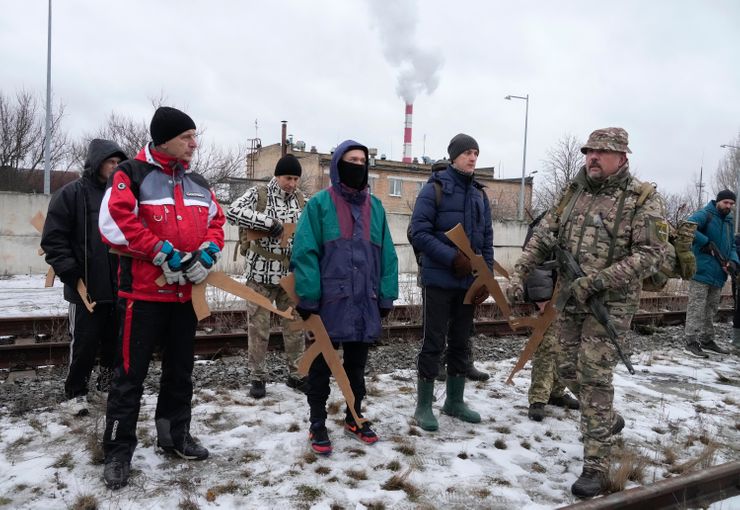
The immediate state of the Russian advance was uncertain, but with Ukrainians volunteering en masse to fight back alongside regular army units, it seemed that the city’s defenses were offering stiff resistance. Having already ordered men between 18-60 years old not to leave the country, Ukrainian officials said Sunday that they were releasing prisoners with military experience who want to take up arms for their country.
The Russian ground attack came after Russians blew up a gas pipeline in Kharkiv, according to Ukrainian officials who ordered residents to cover their windows with a damp cloth given the “environmental catastrophe” it posed.
A senior U.S. defense official said about two-thirds of the Russian military arrayed around Ukraine has now entered Ukraine and that Russia has launched roughly 320 missiles into the country. The official said the Russian troops are having logistical problems and fuel shortages.
Britain’s defense ministry said while overnight skirmishing in Kyiv had been less intense than on Friday night, Russian forces were attempting to encircle the city. The capital remains under lockdown after its mayor called a curfew from 5 p.m. Saturday until 8 a.m. Monday.
Kyiv Mayor Vitali Klitschko on Sunday told The Associated Press that some Russian attackers are within 20 kilometers (12 miles) of the city center and that he feared about a long siege.
“Right now, we have electricity, right now we have water, and heating in our houses. But the infrastructure is destroyed ... I guess we have not so much time,” Klitschko said.
MANY UKRAINIANS FLEE, SOME RETURN TO FIGHT
Those fleeing Europe’s largest armed conflict since World War II grew to 368,000 Ukrainians — mostly women and children, the United Nations’ refugee agency said. That figure more than doubles the agency's estimate from the day before.
The line of vehicles at the Poland-Ukraine border stretched 14 kilometers (8.7 miles) long, and those fleeing had to endure long waits in freezing temperatures overnight. Over 100,000 people have crossed into Poland alone, according to Polish officials. Another 66,000 refugees have entered Hungary, with more than 23,000 entering on Saturday alone, according to the Hungarian officials.
Amid the rush to escape the bombs and tanks, a trickle of brave men and women headed home to defend Ukraine. At a border crossing in southern Poland, Associated Press journalists spoke to people in a line heading against the tide. They included 20 Ukrainian truck drivers who worked in Europe and wanted to face combat.
THE WORLD MOVES TO PUNISH RUSSIA FURTHER
Following massive economic sanctions, the European Union moved to close its airspace to Russia’s airlines and fund supplies of weapons to Ukraine as well as target pro-Kremlin media outlets that are spreading disinformation about the invasion.
European Commission President Ursula von der Leyen said Sunday “we are shutting down the EU airspace for Russians.” She also said the commission wants “for the first time ever” to finance the purchase and delivery of weapons to a third-party county under attack. The foreign ministers of EU nations are meeting and expected to back the plan.
Japan joined the U.S. and European nations in cutting top Russian banks off from the SWIFT international financial messaging system. Japan will also send $100 million in emergency humanitarian aid to Ukraine.
GERMANY ANNOUNCES SIGNIFICANT MILITARY SHIFT
A day after Germany, the EU's economic motor, announced it would send military aid to Ukraine, German Chancellor Olaf Scholz said his government will increase its own defense spending to rearm amid the uncertainty of Putin’s ambitions. This move showed how Russia's invasion of Ukraine was challenging decades of European security and defense policies.
Scholz’s pledge to dedicate 100 billion euros ($113 billion) to a special fund for its armed forces would raise Germany's defense spending above 2% of GDP, satisfying a longstanding request by NATO allies for Europe’s largest economy to do more for the continent’s security.
Germany announced Saturday that it would send 1,000 anti-tank weapons and 500 Stinger surface-to-air missiles to Ukraine. Those weapons are in addition to the 400 German-made anti-tank weapons Germany also approved to be shipped from the Netherlands.
The U.S. has also pledged an additional $350 million in military assistance to Ukraine, including anti-tank weapons, body armor and small arms.
RUSSIANS AGAINST THE WAR
Defying crackdowns by police, demonstrators marched in city centers from from Moscow to Siberia chanting “No to war!”
In St. Petersburg, where several hundred gathered in the city center, police in full riot gear were grabbing one protester after another and dragging some into police vans, even though the demonstration was peaceful. Footage from Moscow showed police throwing several female protesters on the ground before dragging them away.
According to the OVD-Info rights group that tracks political arrests, by Sunday evening police detained at least 1,474 Russians in 45 cities over anti-war demonstrations that day, bringing the total detained in the last few days to over 5,000.
“I have two sons and I don’t want to give them to that bloody monster. War is a tragedy for all of us,” 48-year-old Dmitry Maltsev, who joined the rally in St. Petersburg, told The Associated Press.
___
Also, read here about the role religion plays in the conflict.
___
Associated Press writers around the world contributed to this report.
___
Follow AP’s coverage of the tensions between Russia and Ukraine at https://apnews.com/hub/russia-ukraine